Wolf
Mine Type: Pit, Underground
Tags: ankerite archean arsenopyrite basalt biotite calcite chert chlorite greenstone belt magnetite proterozoic pyrrhotite
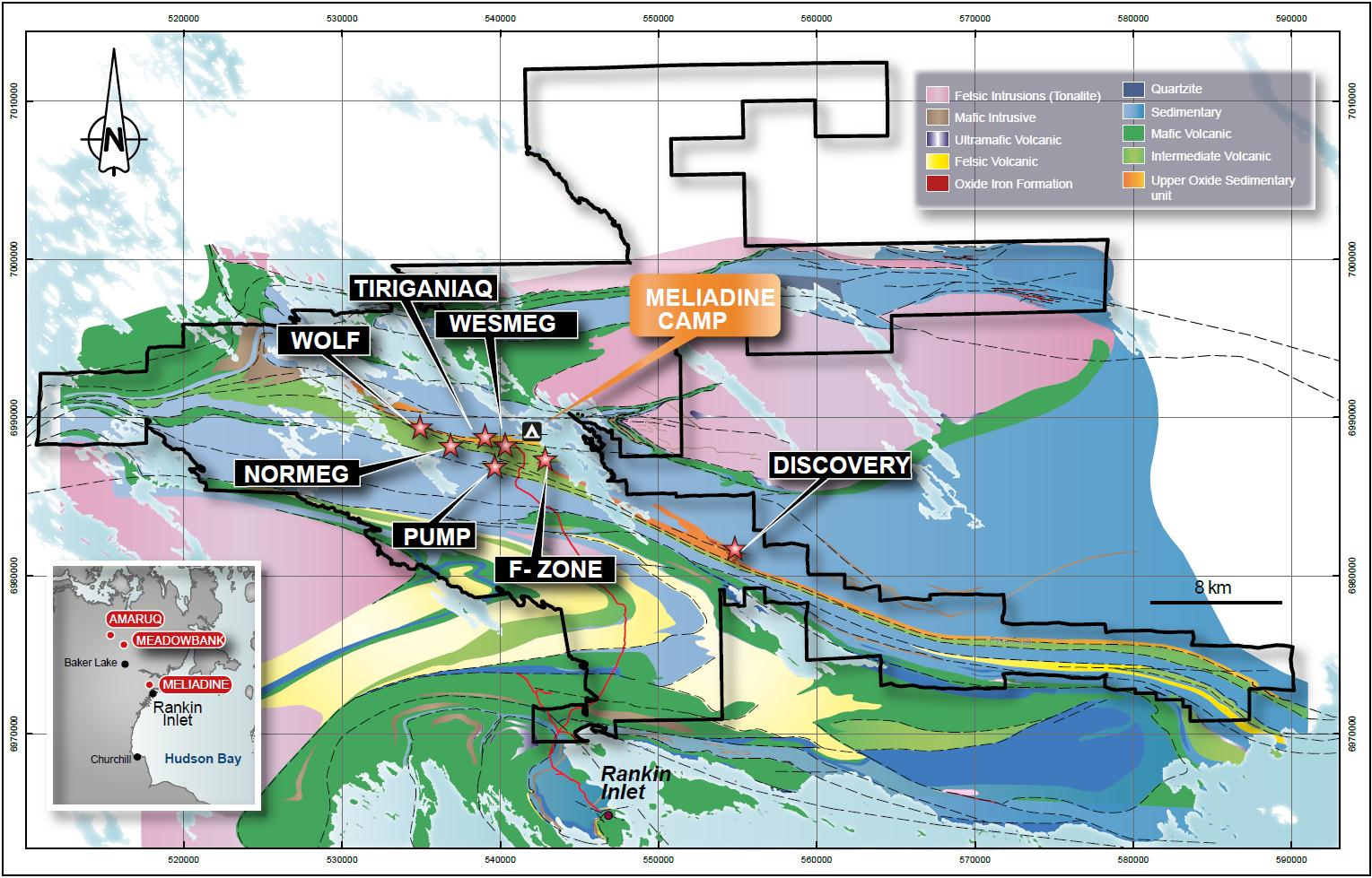
The Meliadine gold project (including the Wolf, Normeg, Wesmeg, Pump, West F-zone, F-zone and Discovery deposit) is located in the Kivalliq District of Nunavut in northern Canada, approximately 25 km northwest of Rankin Inlet on the west coast of Hudson Bay. A private all-weather access road constructed by Agnico Eagle connects Rankin Inlet to the Meliadine project. The current Meliadine exploration camp is located on the shore of Meliadine Lake, approximately 2.3 km east of the Tiriganiaq deposit.
The physical features of the Meliadine region have largely been determined by glaciation. The terrain consists predominantly of broadly rolling uplands and lowlands with little topographical relief (very few hills). Rankin Inlet is located on the shore of Hudson Bay with a mean elevation of 28 m above sea level. Strung out across the landscape are long, sinuous eskers. This undulating landscape is studded with innumerable lakes, ponds, and wetlands. Cryosols are the dominant soils, and are underlain by continuous permafrost with active layers that are usually moist or wet throughout the summer.
Regional geology: Rankin Inlet Greenstone Belt
Located in the Northwest Hearne Sub-domain of the Churchill Structural Province that forms part of the northern Canadian Shield. Supracrustal rocks of this belt consist of mafic volcanic rocks, felsic pyroclastic rocks, sedimentary rocks and gabbro sills of about 2.7 billion years old that have been polydeformed and metamorphosed (Bannatyne, 1958; Laporte, 1983; Tella et al., 1986; Tella, 1994).These rocks were deformed in both the Archean and Proterozoic eras.
Meliadine area regional geology:
Mineralization:
The stratigraphic sequence in the Wolf deposit area strikes northwest-southeast and dips 70º to the north. The Wolf deposit is divided into two areas: the northern Wolf North is hosted in stratigraphy similar to the Tiriganiaq deposit, while the southern Wolf Main is hosted in stratigraphy similar to the Wesmeg deposit.
Clastic turbidites of the Sam Formation are the oldest (northernmost) rocks. These overlie the Upper Oxide Formation and its uppermost portion, the “Upper Oxide Iron Formation”, which hosts the Wolf North mineralized zones.
Wolf vertical cross section at 9950E (local grid) showing geology and lode wireframes (indicated by red ore zones):
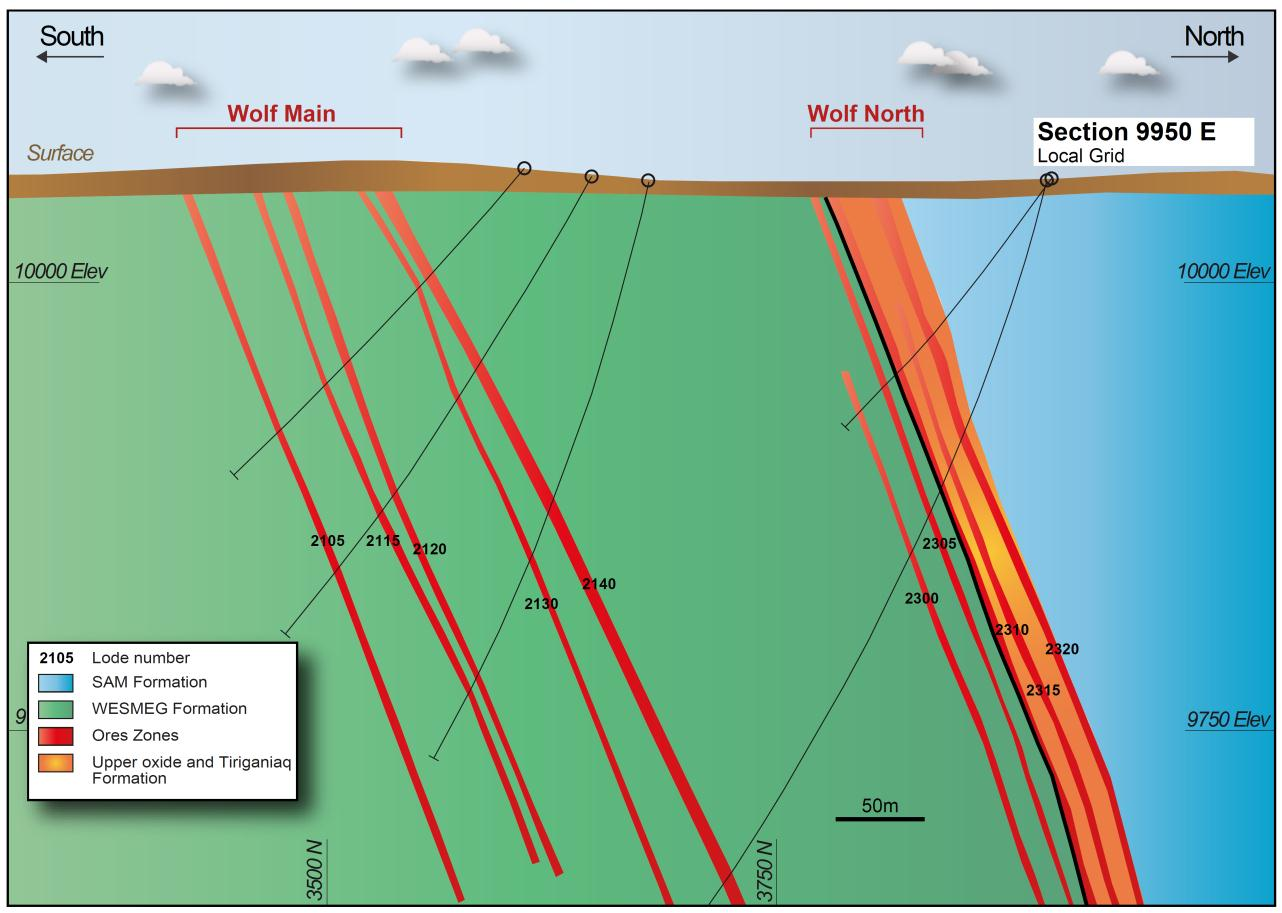
Chlorite-rich massive basalts of the Wesmeg Formation form the structural footwall to the sequence. Within the Wesmeg Formation are chert-magnetite-chlorite iron formations of the Lower Lean Iron Formation that host the Wolf Main mineralization.
East-west structures intersecting the dominant east-southeast stratigraphic trend may control the gold mineralization at Wolf North and Wolf Main.
Mineralization at the Wolf deposit is divided into the 2300 series (resembling Tiriganiaq) and the 2100 series (similar to Wesmeg, Pump and F zone).
The 2300 series lode mineralization is strongly associated with shearing and quartz veining within the Upper Oxide Iron Formation and thus is analogous with the 1000 lode series and the 1100 lode at Tiriganiaq in setting and character. Gold mineralization occurs as disseminated and coarse blebs of gold within sheared, silica-replaced iron formation and within coarse arsenopyrite and pyrrhotite concentrations in veins. The 2310 lode is analogous with the 1000 lode at Tiriganiaq. Gold mineralization occurs as free gold in laminated and non-laminated quartz veins with lesser concentrations of arsenopyrite and pyrrhotite.
As at Wesmeg, Pump and F zone, the 2100 series lodes were defined by tracing areas of mineralization along the Lower Lean Iron Formation. Free gold occurs as discrete blebs in pyrrhotite and quartz shears and to a lesser extent along fractures and grain boundaries in large recrystallized arsenopyrite.
Alteration envelopes occur adjacent to quartz-calcite veining and are characterized by ankerite-, silica-, chlorite- and biotite-bearing assemblages that overprint the pre-existing regional greenschist metamorphic facies.
Note:
For mineral resources (as at December 31, 2010):
- Indicated resources were estimated to the 9.95 m elevation using a gold cut-off grade of 2.17 g/t.
- Inferred resources were estimated to the 9.95 m elevation using a gold cut-off grade of 2.5 g/t, and below the 9.95 m elevation using a gold cut-off grade of 5.5 g/t.
- The table presents the combined resource figures. The contained gold in metric tonnes was calculated by goldmap.info.
For mineral resources (as at December 31, 2014):
- Cut-off grades for underground resources classification - 3.96 g/t
- Cut-off grades for ultimate pit design and open pit resources classification - 2.46 g/t
- Indicated resources are diluted
- The table presents the combined resource figures. The contained gold in metric tonnes was calculated by goldmap.info.
History, local geology, deposit geology, and deposit type are described under the Tiriganiaq deposit.
Mineral Resources (Dec. 31, 2010)
| Class | Ore (ktonnes) | Au grade (g/t) | Au (kg) | Au (oz * 1000) |
|---|---|---|---|---|
| Indicated | 183.00 | 3.79 | 693.57 | 22.00 |
| Inferred | 947.00 | 5.24 | 4966.01 | 160.00 |
Mineral Resources (Dec. 31, 2014)
| Class | Ore (ktonnes) | Au grade (g/t) | Au (kg) | Au (oz * 1000) |
|---|---|---|---|---|
| Indicated | 498.00 | 3.98 | 1983.91 | 64.00 |
| Inferred | 2407.00 | 5.98 | 14395.31 | 462.00 |
Source:
-
Updated Technical Report on the Meliadine Gold Project, Nunavut, Canada
(12.03.2015, Toronto)
Authors: Connell Larry, Petrucci François, Larouche Julie, Caron Denis, Laflamme Dany, Robichaud François, Proulx Alexandre -
Technical Report on the December 31, 2010, Mineral Resource and Mineral Reserve Estimate,
Meliadine Gold Project
(16.02.2011, Nunavut)
Authors: Duquette Dyane, Matte Pierre, Caron Bertho, Connell Larry, Fournier Julie, Petrucci François