903 Zone
Phase: Exploration
Mine Type: Pit, Underground
Tags: albite alkaline ankerite archean argillite arsenopyrite basalt breccia calcite carbonatization chlorite conglomerate diabase dolomite dyke galena granite greenstone belt greywacke hematite komatite lamprophyre magnetite mariposite monzonite pyrrhotite sandstone schist sericite silicification siltstone specularite stock stockwork syenite talc
Canada, Ontario.
The 903 zone deposit is part of the so-called Garrison property, which also includes Garricon and Jonpol.
History:
1945 to 1947: Wright-Hargreaves Mines Ltd. diamond drilled 8 holes totalling 1,944 ft on claim no. 43903 (now patented), part of a contiguous 10 claim group in north central Garrison Township (Satterly 1949).
1988: By this date, Lac Minerals Ltd. had acquired the (now patented) claims formerly held by Wright-Hargreaves Mines and adjacent Hastings claims. Lac completed 17 drill holes totalling 4,823 m on the 903 Zone.
1990: Jonpol and T & H Resources Limited concluded an option agreement with Lac Minerals Ltd. which expanded the existing property and allowed Jonpol and T & H the opportunity to investigate the 903 and Hastings gold zones (specifically claims L43903 of the Wright- Hargreaves Group and L43862 of the Hastings Group) which extend eastward onto the southeast corner of the Garrison Property (claim L29734) (Squair, 2000).
1991: The Lac Minerals agreement was terminated and the Hastings and Wright-Hargreaves properties along with five peripheral claims south of the Garrcon were returned to Lac (Squair, 2000).
2004 to 2008: Val Gold completed no work on the 903 Zone.
2009 to 2015: Northern Gold completed 6 drill holes totalling 1,914 m during its 2013 903 Zone diamond drill program. The 2011 IP geophysical survey also covered the 903 area as did the 2010 and 2013 magnetic and VLF/EM survey.
In 2013, Northern Gold completed six drill holes (903-13-01 to 06) totalling 1,986 m on the 903 Zone, including 72 m in the failed hole 903-12-02.
Regional geology: Abitibi greenstone belt
Abitibi greenstone belt of the Superior province of the Canadian Shield. The area consists mostly of felsic to mafic volcanic rocks of Archean age together with related dioritic sills which are concordant to the regional rock formations. These volcanic and intrusive rocks have generally been metamorphosed to the greenschist facies.
The Superior Province is the largest exposed Archean craton in the world and hosts several world class gold deposits. It has yielded nearly 300 million ounces of gold from hundreds of deposits since the beginning of the twentieth century. One prominent characteristic of all significant gold deposits in the Superior Province is their occurrence within or immediately adjacent to greenstone belts. Another characteristic is their occurrence within major tectonic zones which comprise a series of shear zones (Colvine et al., 1988). The Superior Province is divided into four major subprovince types (Card and Ciesielski, 1986): volcano-plutonic, plutonic, metasedimentary, and high metamorphic grade gneiss. The boundaries of these subprovinces are either major dextral, transcurrent, east-striking faults, or zones of structural and metamorphic transition.
The greenstone belts which host the gold deposits occur as east-north-easterly trending ribbon domains in the volcano-plutonic terrains. They typically consist of mafic to ultramafic and felsic metavolcanic …
Local geology:
Description of local geology in the section deposit Garrcon.
Deposit geology:
Extensive drilling by Osisko in 2016 to 2018 has helped classify the mineralization style at the 903 Zone as a traditional “syenite associated deposit”. Although no geochronology has been conducted, the syenites are likely associated with the Timiskaming magmatic event, recognized along the Abitibi, with alkaline characteristics, which occurred approximately between 2,680 and 2,672 Ma (Corfu et al, 2001).
Host rocks consist of albite-sericite-chlorite altered ultramafic to mafic volcanics. Alteration is primarily albite-hematite-specularite.
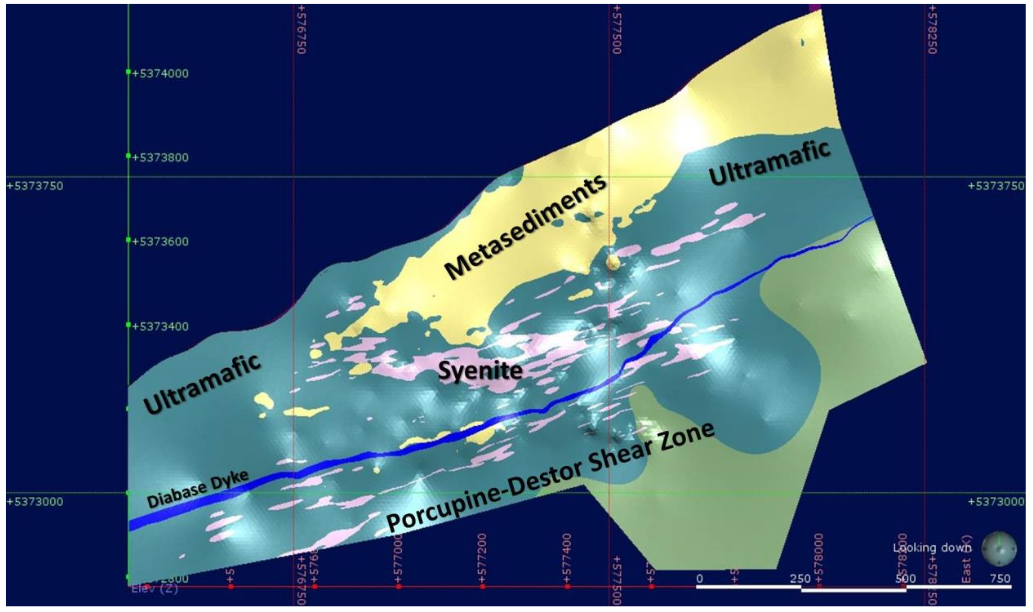
Three different magmatic groups are identified at the 903 Zone. Syenite dykes are the most important since the deposit can be considered mostly “syenite-associated”. The syenites are typically hosted by deformed ultramafic rocks, although they less commonly occur within the mafic volcanics. Although most of the primary textures in the syenites have been totally or partially destroyed by alteration, three families of syenite dykes were identified at the 903 Zone:
- Fine-grained grained “crowded” porphyritic syenite: These syenite intrusions occur most abundantly in the eastern part of the 903 Zone. The syenites are generally fine-grained, with less than 25% of matrix visible and with phenocrysts less than 4 mm. Despite increased intensity of alteration, feldspar phenocrysts are still visible. This helps with identification during logging.
- Fine-medium-grained porphyritic syenite: Generally with a greater percentage of matrix (>25%), with more separation of phenocrysts. This phase appears to be least preserved in terms of texture.
- Coarse-grained porphyritic syenite: These syenites are coarse-grained with euhedral feldspar phenocrysts up to 3 to 4 cm long. This family of syenites is more dominant in
the western part of the 903 Zone.
Accessory sulfide minerals associated with anomalous gold grades are reported to include pyrite, hematite, chalcopyrite, molybdenite and galena. The presence in hornblende altered
mafic volcanic rocks and quartz-biotite-cordierite schists and/or gneisses may be a contact metamorphic aureole around the Garrison Stock, located several hundred metres south of the 903 Zone.
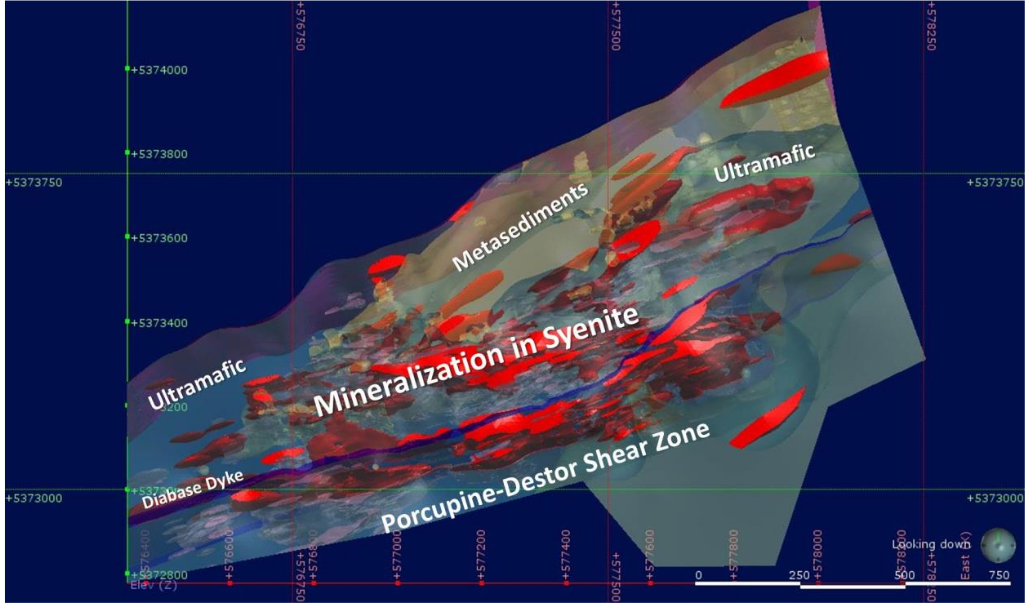
Fractured and/or pyritic and/or quartz vein bearing syenite dikes within the 903 Zone are anomalously auriferous along significant core lengths (ranging from about 30 cm to about 10 m). Historic and current drilling has traced the zone along 1,840 m of strike length. The zone remains open at depth and along strike.
Deposit types:
See the information in the Garrcon deposit section.
Note:
Notes for mineral resources for the effective date 2019-02-19:
- Ore weight and gold ounce values are rounded to the nearest thousand, which may result in visible discrepancies.
- Notes from goldmap.info: mineral resources are presented in aggregate, without differentiation by mining method. The calculation was completed by goldmap.info and includes gold resources expressed in metric tonnes and average grades. The original estimates were based on different cut-off grades: 0.4 g/t for open-pit and 3 g/t for underground.
Notes for mineral resources for the effective date 2020-11-25:
- The mineral resource for O3 Mining’s Garrison deposits has been updated since the previous estimate in 2019 due to updated geologic modelling, updated QA/QC and updated gold prices.
- The base case cut-off grade is 0.30 g/t Au based on mill recoveries of 90.5% at 903. Processing + G&A costs of C$16.90/t and a US$1400/oz Au were used, with smelter terms as detailed in the notes below.
- The open pit mineral resource has been confined by a “reasonable prospects of eventual economic extraction” pit shell generated using the following assumptions: US$1,800/oz. Au at a currency exchange rate of US$0.75 per C$1.0; 99.95% payable Au; C$4.30/oz Au off-site costs (refining, transport and insurance); a 2% NSR royalty; C$14.50/t process and G&A costs; C$2.40/t mining costs and pit slopes of 25° in the overburden and 40° below the overburden. Metallurgical recovery is 90.5% at 903.
- The specific gravity of the deposit has been determined by lithology as being between 2.74 and 3.32.
- Numbers may not add due to rounding.
Mineral Resources (Feb. 19, 2019)
| Class | Ore (ktonnes) | Au grade (g/t) | Au (kg) | Au (oz * 1000) |
|---|---|---|---|---|
| Measured | 4862.00 | 1.27 | 6174.74 | 198.00 |
| Indicated | 10872.00 | 1.00 | 10894.10 | 350.00 |
| Inferred | 6961.00 | 1.01 | 7011.78 | 225.00 |
Mineral Resources (Nov. 25, 2020)
| Class | Ore (ktonnes) | Au grade (g/t) | Au (kg) | Au (oz * 1000) |
|---|---|---|---|---|
| Indicated | 27558.00 | 0.84 | 23231.39 | 747.00 |
| Inferred | 30760.00 | 0.69 | 21224.40 | 682.00 |
Source:
-
N.I. 43-101 TECHNICAL REPORT & PRELIMINARY ECONOMIC ASSESSMENT OF THE GARRISON PROJECT
(27.01.2021, Toronto)
Authors: Raponi Tommaso Roberto, Elfen Scott, Weston Scott, Petrina Mike, Bird Susan -
A Mineral Resource Estimate For The Garrcon, Jonpol And 903 Zones At The Garrison Project, Garrison Township, Black River - Matheson Area, Northeastern Ontario
(04.04.2019, Toronto)
Authors: Hennessey Terrence